Knowing what makes a rate high is one thing. Getting the lowest legitimate price on your own policy is a separate skill — and it has less to do with your driving record than most Oklahoma drivers assume. Two people with identical risk profiles can walk away with very different premiums based purely on how they shopped, what they asked for, and how they structured the policy. This is the part of finding the cheapest auto insurance that’s actually in your control.
Start With an Anonymous Quote Before You Share Anything
The single biggest mistake drivers make is handing over personal details before they see a price. A phone number invites a sales call. A credit pull can raise the number before you’ve compared anything. And once a rep has your information, the quote often arrives pre-loaded with coverages you didn’t ask for.
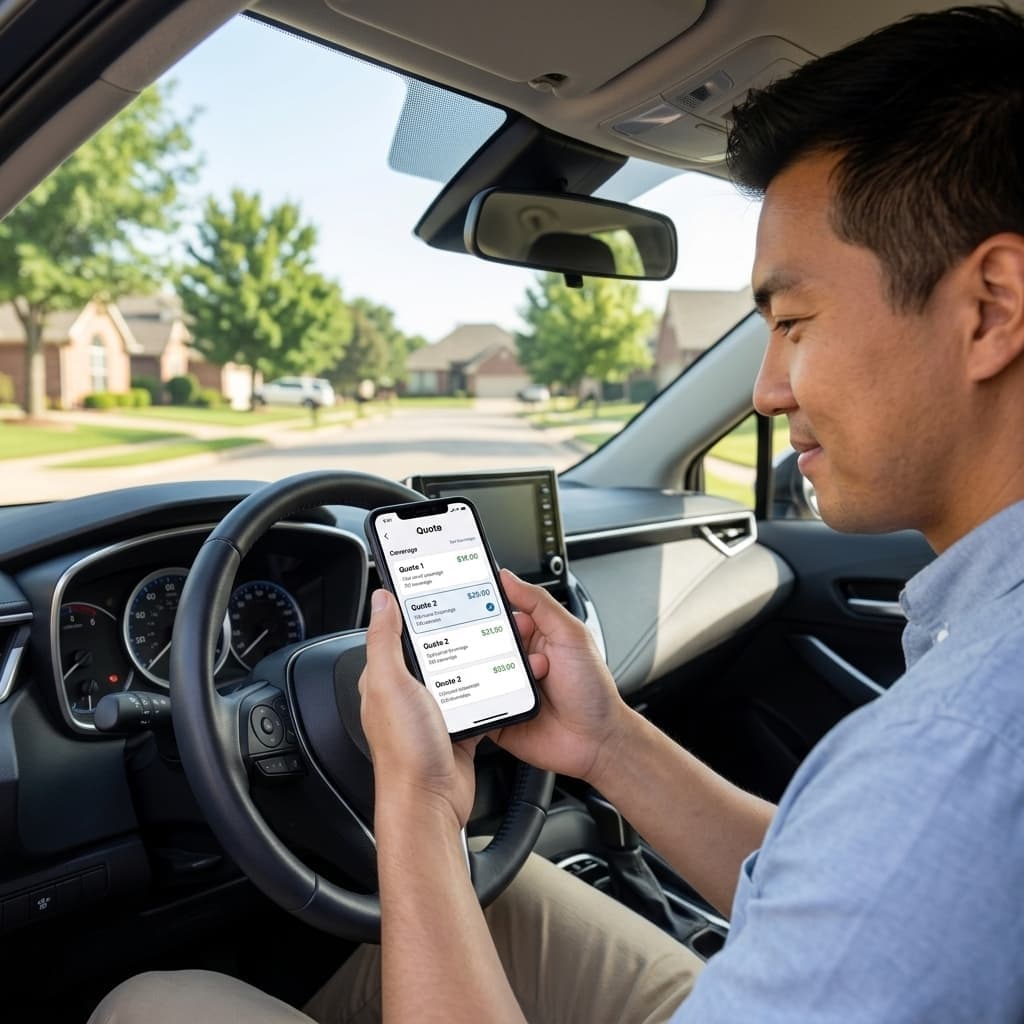
Skipping that friction is the fastest way to a clean baseline. Our anonymous quoting process returns a real Oklahoma price in about 60 seconds with no phone call and no credit check, so the first number you see reflects the coverage and the vehicle — not how aggressively someone wanted to upsell you. Because nothing is tied to a sales conversation, you can adjust the policy and watch the price move in real time instead of starting over each time you want to compare.
Price the Coverage You Actually Need, Then Add Only What’s Required
Oklahoma law requires liability of at least 25/50/25 — $25,000 per person and $50,000 per accident for bodily injury, plus $25,000 for property damage, per the Oklahoma Insurance Department. Liability-only at that limit is the lowest-priced policy that’s still legal to drive with, which makes it the natural starting point when you’re chasing the cheapest number.
From there, build up only where you have a reason to. Comprehensive and collision protect the vehicle itself, and if your car is financed, a lienholder will usually require both — so the cheapest policy for a financed car is the lowest-priced full coverage that satisfies the loan, not liability alone. The point is to make each coverage a deliberate choice. If you’re weighing where a given coverage lands on your bill, the mechanics of how an Oklahoma rate is calculated explain why the same coverage costs different amounts for different drivers.
Use the Deductible as a Price Lever
The deductible — what you pay out of pocket before coverage kicks in on comp and collision — is one of the few dials you can turn to move a premium down immediately. A higher deductible lowers the monthly cost because you’re absorbing more of a smaller claim yourself; a lower one raises it. There’s no universally “right” number, only the trade-off that fits your budget: how much you could comfortably cover at once if something happened tomorrow, weighed against how much you want to save every month until then.
Because an anonymous quote updates instantly, you can test a $500 deductible against a $1,000 one and see the exact dollar difference before committing. That’s a more honest way to decide than guessing, and it’s a lever that works regardless of your driving history.
Stack the Discounts That Don’t Depend on Your Record
Some of the most reliable savings have nothing to do with how you drive. Two are worth setting up on purpose:
A companion policy discount applies when you pair auto insurance with a renters policy through us — useful for the large share of Oklahoma drivers who rent an apartment or home rather than own. A multi-vehicle discount can lower the overall amount you pay when you add a second vehicle to the same policy, so two cars on one policy often costs less per car than two separate policies.
These are structural savings: they’re baked into how the policy is set up rather than earned over years of clean driving, which means a newer driver can capture them just as easily as a veteran one.
Don’t Let Coverage Lapse — It Quietly Raises Your Next Quote
One of the most avoidable ways to lose a cheap rate is letting a policy lapse. A gap in coverage — even a short one between policies — signals higher risk to insurers, and it can push your next quote up regardless of how clean your record is otherwise. If you’re switching providers to save money, the goal is a same-day handoff: the new policy starts the moment the old one ends, with no uninsured days in between. Buying online with instant proof of coverage makes that overlap easy to line up, which protects the low rate you just worked to find.
Frequently Asked Questions
What’s the fastest way to find the cheapest auto insurance in Oklahoma? Start with an anonymous quote that skips the phone call and credit check, price liability-only at the state’s 25/50/25 minimum as your baseline, then add comprehensive and collision only if you need or are required to carry them.
Does raising my deductible really make the policy cheaper? Yes. A higher deductible on comprehensive and collision lowers your premium because you take on more of a smaller claim yourself. The savings only make sense if you could comfortably cover that deductible out of pocket if you needed to.
Can I lower my rate without a clean driving record? Often, yes. Structural discounts like a companion policy (bundling renters insurance) or a multi-vehicle discount don’t depend on your driving history, so they’re available even to newer or higher-risk drivers.