
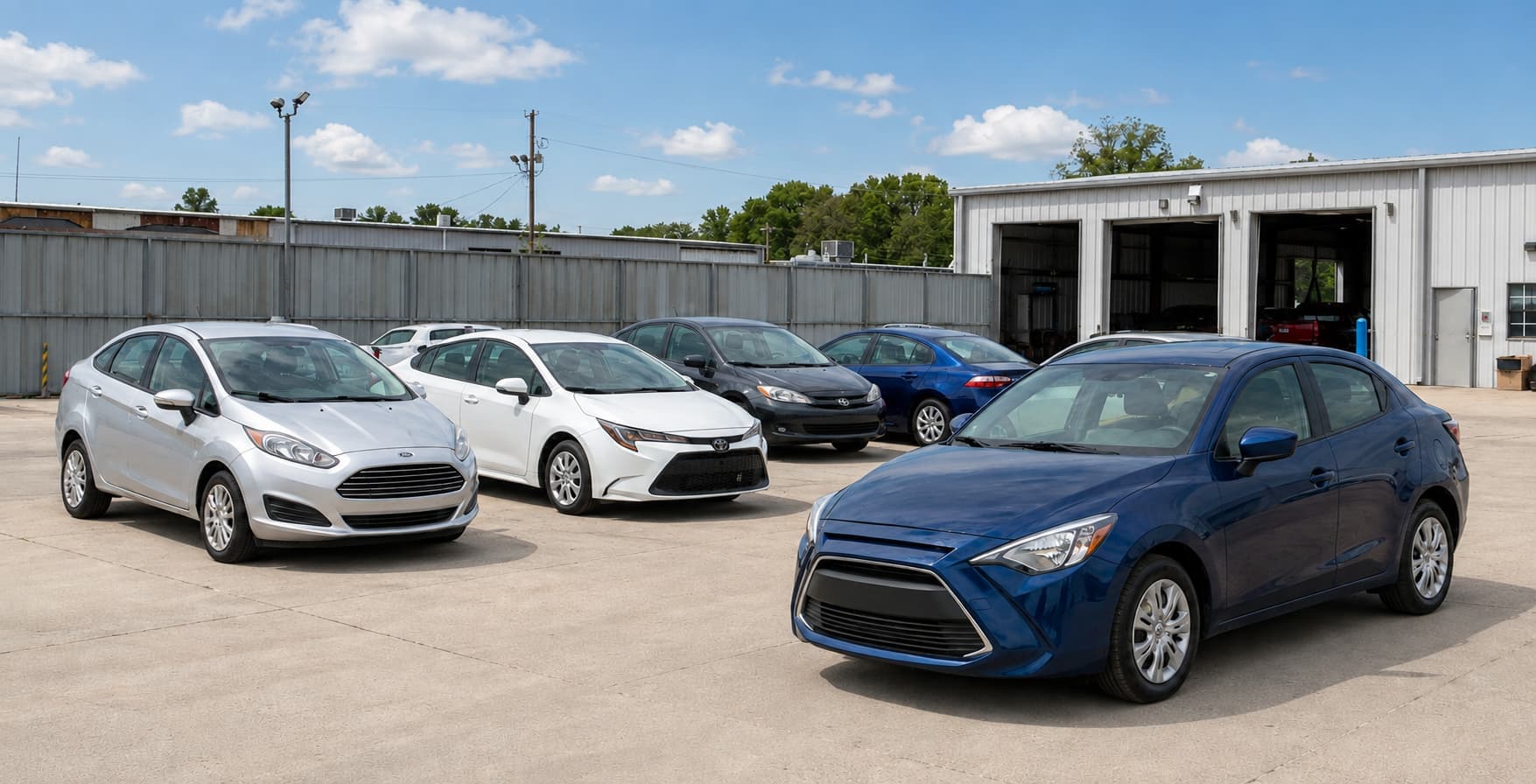
Your car is in the shop after an accident, and now you need something else to drive.
This probably isn’t the time to hunt for the fanciest rental on the lot. You need a car that can handle your commute, errands, school pickup, and everyday driving without creating another expense while you’re waiting for repairs.
If your claim includes rental reimbursement, the car you choose matters even more.
Enterprise says rental benefits commonly have a daily limit and a total limit. If your benefit provides a flat daily amount, the rental rate plus tax generally needs to stay within that amount if you want to avoid paying part of the rental yourself. Enterprise also notes that insurance-related rental rates can vary by market.
Then there’s gas.
As of August 12, 2026, regular gasoline averaged about $3.66 per gallon in Oklahoma. If you’re still making your normal commute while your own car is being repaired, fuel economy can make a noticeable difference over a week or two.
So which Enterprise cars are worth looking at first?
Here are five practical choices, ranked with the rental rate, fuel economy, space, and potential out-of-pocket costs in mind.
One note before we start: Enterprise rents vehicles by class, so the exact model at your location isn’t guaranteed. The vehicles below are models Enterprise currently uses to represent these rental classes.
1. Mitsubishi Mirage: Start Here When Cost Matters Most
If the goal is keeping the rental as inexpensive as possible, the Mitsubishi Mirage is the logical place to start.
Enterprise currently uses the Mirage as the example for its Economy class. The class seats four people and has room for two bags. Enterprise also describes Economy rentals as small vehicles that typically offer strong fuel efficiency.
That combination works well after a claim because you’re paying for transportation rather than extra space you may not use.
The fuel numbers are especially strong. A 2024 automatic Mitsubishi Mirage is EPA-rated at 39 mpg combined, including 36 mpg city and 43 mpg highway.
At Oklahoma’s current average of roughly $3.66 per gallon, that works out to about $9.38 in gasoline for every 100 miles.
For someone driving 500 miles while their car is being repaired, that’s roughly $47 in gas at that mileage.
The bigger advantage, though, may be the rental class itself.
If your claim has a fixed daily rental amount, Economy is one of the first classes worth pricing because keeping the rental rate within that allowance can matter more than squeezing another mile or two out of a gallon of gas.
Before choosing it: Ask Enterprise for the full Economy rate including tax and compare that number with the daily amount available through the claim.
If the entire rate fits, you may be able to keep the rental portion of the claim very simple.
2. Nissan Versa: Spend a Little More Space, Not Much More Gas
The Nissan Versa is where this list gets interesting.
Enterprise currently uses the Versa as its Compact rental example. It seats five rather than four while still providing the easy parking and fuel efficiency you’d expect from a smaller car.
A 2025 automatic Versa is EPA-rated at 35 mpg combined, with 32 mpg city and 40 mpg highway.
Using the same Oklahoma gas price, that’s approximately $10.46 per 100 miles.
Compare that with the Mirage at about $9.38.
The difference is only around $1.08 in fuel for every 100 miles driven.
That’s the useful comparison.
If you’re putting 500 miles on the rental, the Versa would cost only about $5 more in fuel based on those MPG figures and today’s Oklahoma gas price.
So the important question isn’t really whether the Compact burns too much gas.
It’s how much Enterprise charges to move from Economy to Compact.
If the claim rate makes the Versa only a couple of dollars more per day—or the Compact class still falls entirely within your rental allowance—the extra seating and everyday usability may be worth much more than the relatively small difference at the pump.
Before choosing it: Ask for the Economy and Compact claim rates side by side.
If Compact is $2 more per day during a 14-day repair, that’s a $28 difference. If it’s $10 more per day, you’re looking at $140.
Same car decision. Very different budget decision.
3. Toyota Corolla: The Strongest All-Around Choice
The Toyota Corolla is where I’d look if the smaller cars feel limiting but you still want to keep costs under control.
Enterprise currently uses the Corolla as its Midsize example. It seats five and holds three bags, giving you more luggage room than the Economy and Compact examples. Enterprise describes its Midsize class as offering more passenger and luggage space while remaining fuel efficient.
And the fuel penalty for moving up isn’t particularly large.
Depending on the version, a 2026 gas-powered Corolla is EPA-rated at around 34 to 35 mpg combined.
At 34 mpg and $3.66 per gallon, you’re looking at approximately $10.76 in fuel per 100 miles.
That’s only about $1.38 more per 100 miles than the Mirage example.
So if you’re deciding between the Economy and Midsize classes, gas probably shouldn’t make the decision for you.
The rental rate should.
If the Corolla class fits within the amount available through the claim, you’re getting five seats, more luggage room, and good fuel economy without jumping straight into a larger sedan or SUV.
This can become especially valuable when a repair takes longer than expected. Enterprise says accident-related rentals can average close to two weeks, although the actual length depends on the repair and claim.
A car that feels fine for two days can feel very different after two weeks of commuting, errands, passengers, and groceries.
Before choosing it: Compare the Midsize rate with Compact rather than looking only at MPG.
If both fit within the claim allowance, the Corolla class may give you noticeably more usable space for very little difference in fuel cost.
4. Volkswagen Jetta: More Room Without a Big Fuel Penalty
Moving into a larger rental class doesn’t automatically mean spending much more at the gas station.
Enterprise currently lists the Volkswagen Jetta as an example of its Standard class. The class seats five and has room for three bags.
The current Jetta also puts up surprisingly good fuel numbers.
A 2026 automatic Jetta is EPA-rated at 34 mpg combined and 40 mpg highway in its base configuration. Other trims are rated at 33 mpg combined.
Using the 34-mpg figure, 100 miles of driving at $3.66 per gallon costs about $10.76.
That’s basically the same fuel-cost example as the Corolla.
For someone with a longer highway commute, that makes the Standard class worth at least checking.
But this is also where you need to stop letting MPG distract you from the larger bill.
Suppose the Jetta class costs $7 more per day than the vehicle your claim amount fully covers.
That doesn’t sound like much while you’re standing at the rental counter.
Keep the car for 14 days and the difference becomes $98.
Even excellent highway mileage is unlikely to recover a $98 rental-rate difference unless you’re driving a substantial number of miles.
Before choosing it: Ask what the Standard class will cost you personally each day after the claim amount is applied.
A fuel-efficient larger car can be a good value. A fuel-efficient larger car with a large daily upgrade charge may not be.
5. Toyota Camry Hybrid: Check the Rate Before You Rule It Out
A Full Size Hybrid probably isn’t the first category you’d expect to see in a budget-friendly rental list.
But the Toyota Camry Hybrid earns a spot because of what happens at the gas pump.
Enterprise currently uses the Camry Hybrid as its Full Size Hybrid example, with five seats and room for three bags.
Depending on the configuration, the 2026 Camry Hybrid is EPA-rated from roughly 43 to 51 mpg combined. The front-wheel-drive LE reaches 51 mpg combined.
At 51 mpg and Oklahoma gas around $3.66, that’s approximately $7.18 in fuel per 100 miles.
That’s actually less than all four gasoline-car examples above.
Compared with the Versa example, the difference is about $3.28 per 100 miles.
Compared with the Corolla or Jetta examples, it’s about $3.59 per 100 miles.
If you’re driving hundreds of miles every week, that starts becoming meaningful.
But here’s the catch:
Cheap to fuel doesn’t necessarily mean cheap to rent.
If the Camry Hybrid costs $12 more per day than a Compact vehicle and you’re personally paying that difference, saving a few dollars every 100 miles in gasoline probably won’t make the upgrade cheaper overall.
On the other hand, rental inventory and claim rates can produce unexpected choices. If Enterprise can put you into the hybrid for little or no additional daily cost, the numbers suddenly look much better.
Before choosing it: Don’t just ask what the hybrid costs.
Ask:
“What would my out-of-pocket difference be per day after the insurance amount is applied?”
If the answer is close to zero, this could be one of the most economical cars on the list for someone who drives a lot.
Compare the Total Cost Before You Choose
The exact vehicle Enterprise has available may differ from the models on this list, since rentals are generally booked by vehicle class.
If you have a choice within the same class and rate, choosing the more fuel-efficient car can help keep gas costs down.
But the rental rate matters more than a small difference in MPG.
For example, if moving from Economy to Midsize costs you an extra $6 per day, a 14-day repair would add $84 to your out-of-pocket cost. That can outweigh a relatively small difference in fuel spending.
A simple order to follow is:
- Check the amount available through the claim.
- Compare the actual Enterprise rates for Economy, Compact, and Midsize.
- Find out exactly what you would pay per day, if anything.
- Then compare fuel economy and space.
For many drivers, Compact is a good place to start because it offers useful everyday space without moving far from Economy-level fuel costs. But if Economy saves you a meaningful amount—or Midsize costs almost nothing extra—the better choice may be different.
The goal isn’t necessarily to rent the cheapest car on the lot.
It’s to choose the car that meets your needs while keeping your total out-of-pocket cost as low as possible.
FAQ
What is the most budget-friendly Enterprise car after an accident?
Enterprise’s Economy class is usually the best place to start for a lower rental rate. Enterprise currently lists the Mitsubishi Mirage as its Economy example.
Does insurance pay for any Enterprise rental car I choose?
Not always. Rental reimbursement may have daily and total limits, so choosing a more expensive vehicle can leave you paying the difference.
Is a Nissan Versa or Toyota Corolla better for a claim rental?
The Nissan Versa may cost less as a Compact rental, while the Toyota Corolla offers more space as a Midsize. Compare the actual daily rates before choosing.
Should I choose the Enterprise rental with the best gas mileage?
Not necessarily. A lower rental rate can save more than a small improvement in fuel economy, especially during a longer repair.
Can I choose a more expensive Enterprise car and pay the difference?
Sometimes. If the upgraded vehicle costs more than the amount available through your claim, you may be responsible for the difference.
How long might I need a rental car after an accident?
It depends on the repair. Enterprise says accident-related rentals can last around two weeks on average, so even small daily costs can add up.