
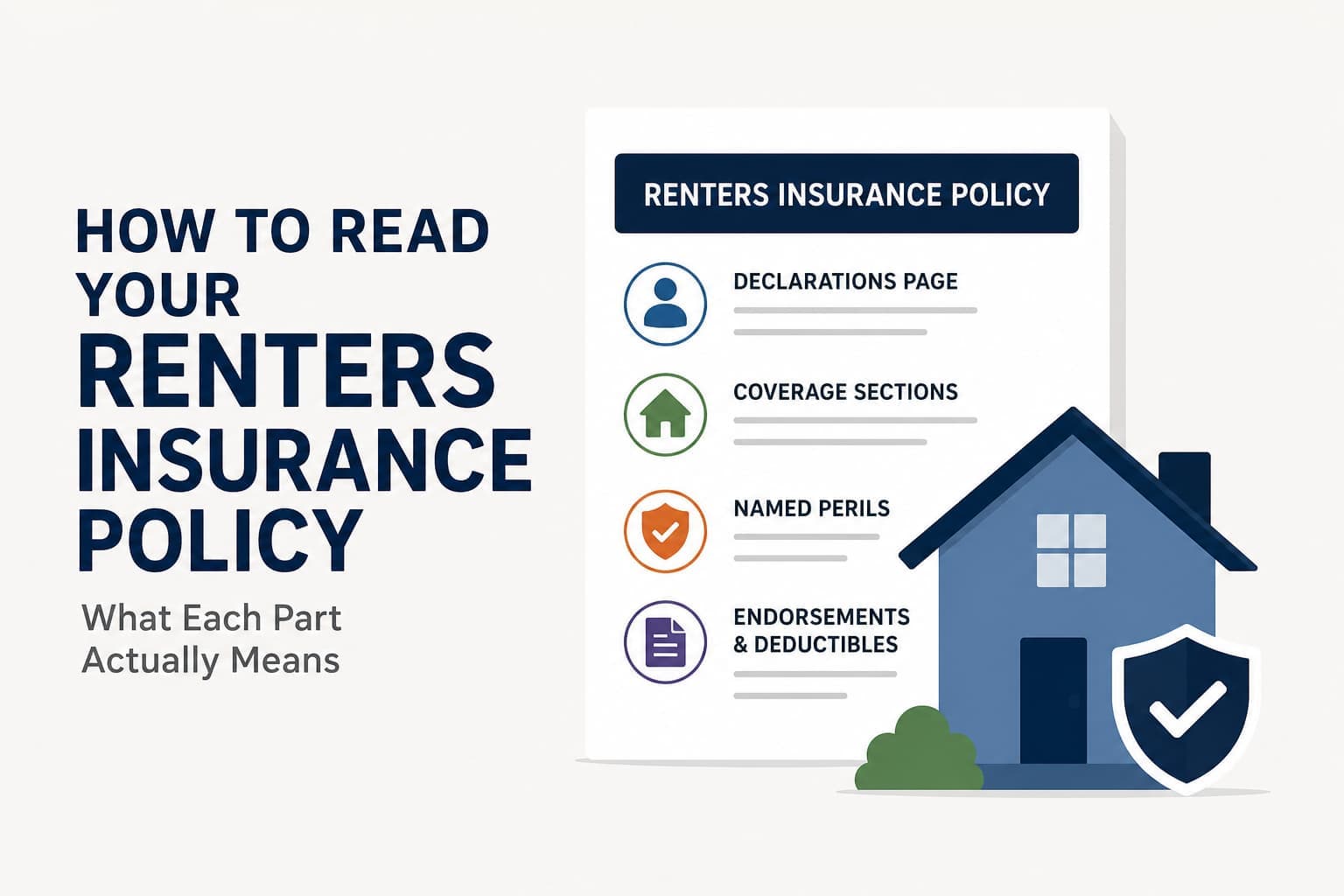
Most people buy a renters insurance policy, file the paperwork somewhere, and never look at it again until something goes wrong. That’s the exact moment you don’t want to be reading it for the first time. A renters insurance policy is a specific document with predictable parts, and once you know what each section is telling you, you can see precisely what you’re protected against — and where the gaps are — before you ever need to file a claim.
Start With the Declarations Page
The declarations page — the “dec page” — is the summary at the front of your renters insurance policy. It’s the single most useful page in the whole document, because it lists your actual numbers: your coverage limits, your deductible, your policy period, and the premium you pay.
This is where you confirm the policy matches what you think you bought. If you asked for $30,000 of personal property coverage, the dec page is where you verify it says $30,000 and not $15,000. Read this page first, every time, because everything else in the policy explains the terms behind these numbers.
The Coverage Sections: Property, Liability, and Loss of Use
The body of a renters policy is organized into coverage types, and knowing which is which tells you what the policy does.
Personal property coverage pays to repair or replace your belongings — furniture, electronics, clothing — after a covered loss. Personal liability coverage protects you if you’re found responsible for someone else’s injury or property damage, such as a guest hurt in your apartment. Loss of use coverage helps with extra living costs, like a hotel, if your rental becomes uninhabitable after a covered event. These three pieces are the core of nearly every renters insurance policy, and each carries its own limit listed back on the dec page.
Named Perils: What the Policy Will and Won’t Respond To
A renters policy doesn’t cover every possible bad event — it covers a specific list of causes, called perils. Fire, theft, vandalism, and certain water damage are commonly named; other causes may not be. This is the part renters skip most often, and it’s where surprises hide.
Two exclusions matter especially in Oklahoma. Standard renters policies typically do not cover flood damage, a gap the Oklahoma Insurance Department specifically warns renters about given the state’s storm and flooding exposure. Wind and hail are usually handled differently from flooding, so two weather events on the same street can land on opposite sides of what your policy covers. If a cause of loss isn’t covered by the base policy, that’s exactly what an endorsement is for.
Endorsements and Deductibles: The Fine Print That Changes Your Payout
Two smaller sections quietly control what you actually receive. The deductible is the amount you pay out of pocket before coverage kicks in on a personal property claim; a higher deductible lowers your premium but means more cost to you at claim time. Endorsements are add-ons that modify the base policy — for example, scheduling a valuable item or adding a coverage the standard form leaves out.
Reading these two together tells you your real out-of-pocket picture. The base policy sets the framework, the deductible sets your share, and endorsements fill the gaps you’ve chosen to close.
Reading the Policy Before You Rent in Oklahoma
The coverage limits that make sense for renters insurance in an Oklahoma apartment often differ from those for a rented house, since apartment communities frequently set their own minimum liability requirements in the lease. Checking your declarations page against what your building actually requires turns the document from fine print into a plan you understand.
Frequently Asked Questions
What is the most important page of a renters insurance policy?
The declarations page. It summarizes your coverage limits, deductible, policy period, and premium in one place, and it’s where you confirm the policy matches what you intended to buy.
How do I know what my renters insurance policy actually covers?
Look at the coverage sections — personal property, personal liability, and loss of use — and then read the list of named perils. The perils list tells you which causes of loss the policy will respond to and which it won’t.
Does a renters insurance policy in Oklahoma cover flooding?
Typically no. Standard renters policies generally exclude flood damage, so if flooding is a concern, that’s a coverage to address separately rather than assuming the base policy includes it.