
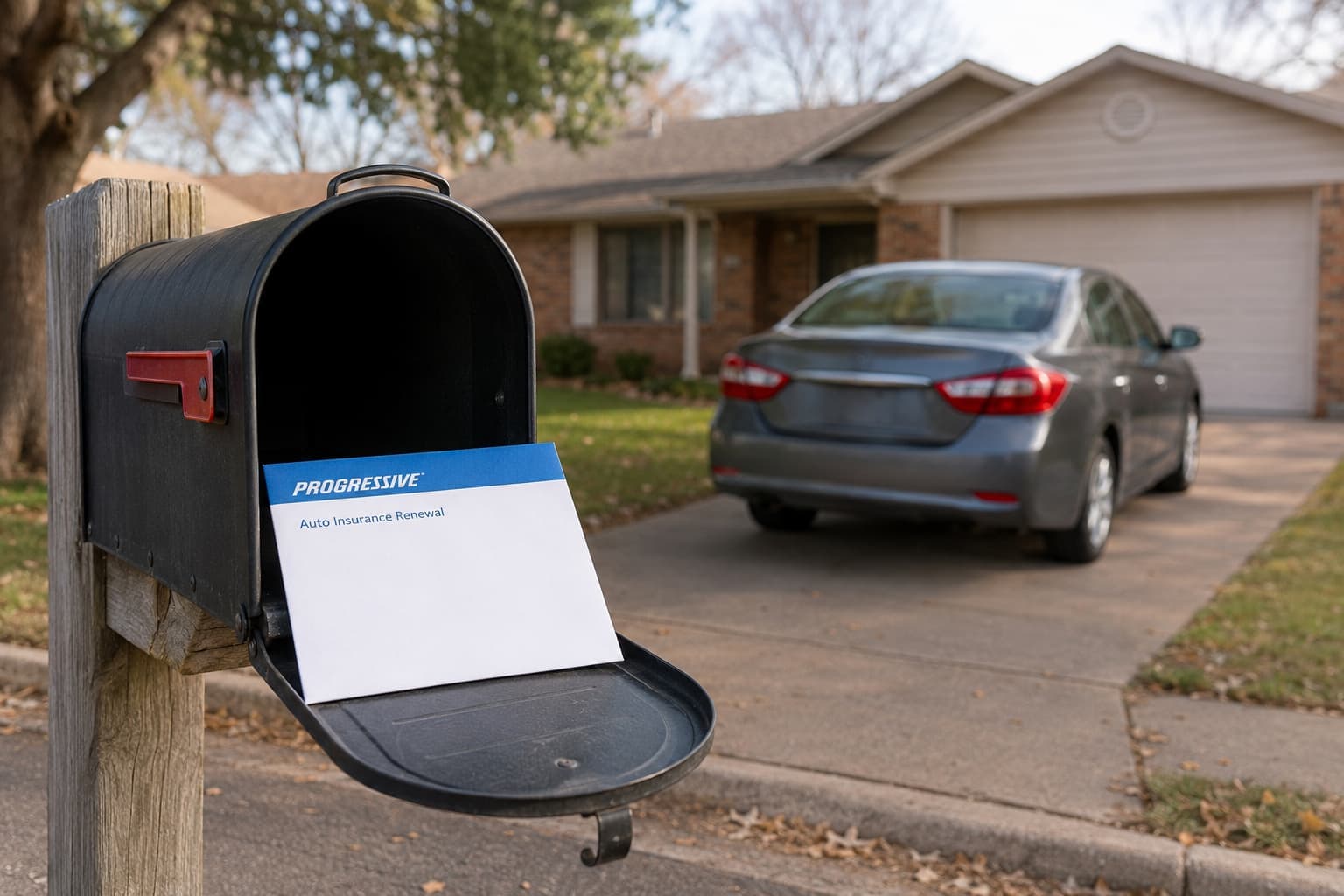
You open your Progressive renewal and the price is higher than it was last term.
Sometimes the reason is easy to spot. Maybe you changed vehicles, moved, added a driver, or updated something else on the policy.
Other times, the renewal looks almost the same and the higher price seems to come out of nowhere.
Before making changes based on the new price, take a closer look at the renewal and compare it with the policy you have now. A change in the premium may be tied to a driver, vehicle, discount, payment detail, or another part of the policy.
The first question to answer is simple:
What changed between your current policy and the new renewal?
Here’s what to check first.
Start With the Total Renewal Premium
The monthly payment is usually the first number people notice.
If you were paying $112 and the renewal says $137, it’s easy to think:
My insurance just went up $25 a month.
That may be true, but start by comparing the total premium for the full policy term.
For example:
- Current six-month premium: $672
- New six-month renewal premium: $822
- Difference: $150
Now you know exactly how much the policy price changed.
That matters because the amount due each month can also be affected by the payment schedule, amount due upfront, number of installments, or other billing details.
So don’t stop at the monthly payment.
Compare the full policy premium first.
Compare the Old Policy With the New Renewal
Once you know the dollar difference, put the two policies side by side.
You don’t need to analyze every line like an insurance professional. You’re looking for anything that changed.
Start with:
- listed drivers
- vehicles
- address
- vehicle information
- liability limits
- payment setup
- discounts
Sometimes the reason becomes obvious pretty quickly.
Maybe someone was added as a driver.
Maybe the address changed.
Maybe a vehicle was replaced.
Maybe something that appeared on the old policy isn’t showing the same way on the renewal.
The goal isn’t to guess why Progressive changed the price.
Find the difference first.
Look for Something That Disappeared
Don’t only look for things that were added.
Something missing from the new policy can be just as important.
Discounts are a good place to check.
If a discount appears on the old policy but not on the renewal, make a note of it. You may want to ask why it changed and whether anything needs to be updated.
Payment information is worth checking too.
Think about whether you recently:
- changed bank accounts
- replaced a debit card
- changed automatic payments
- changed how you pay the policy
- updated account information
A difference in payment details doesn’t automatically mean there’s an error or that it caused the entire increase.
It simply gives you something specific to ask about instead of wondering why the price changed.
Think About What Changed During the Last Policy Term
The answer won’t always be sitting on the renewal paperwork.
Think back over the last several months.
Did anything change involving the drivers, vehicles, address, or how the cars are being used?
For example:
- Did someone in the household become licensed?
- Did you add or replace a vehicle?
- Did you move?
- Did your mileage change considerably?
- Did the way you use the vehicle change?
- Was there a ticket or accident?
- Did anything else change involving a listed driver?
A change may have happened months ago, which makes it easy to forget by the time the renewal arrives.
That’s why it helps to look at both the paperwork and what happened during the policy term.
Why Did My Progressive Insurance Go Up If I Didn’t Have an Accident?
This is where a renewal can get frustrating.
You compare the old policy with the new one and everything looks almost identical.
Same drivers.
Same vehicle.
Same address.
Same liability coverage.
No accident. No ticket.
So why did the Progressive renewal go up?
Your own accident history isn’t the only thing that can affect an insurance renewal.
Insurance prices can also change as insurers update rates based on the claims and costs they expect to pay.
What matters for your review is separating two situations:
Something changed on your individual policy.
Or:
The policy looks essentially the same, but the renewal price changed anyway.
If something on the policy is inaccurate, that needs to be addressed.
If everything appears correct, you can stop searching for a mistake and start deciding whether the renewal still works for you.
If Something Looks Wrong, Correct It First
Suppose the renewal shows an old address.
Or incorrect vehicle information.
Or something involving a driver doesn’t look right.
Correct that before you start comparing prices elsewhere.
A renewal or quote is only as useful as the information behind it.
The same rule applies when you get another insurance quote.
If one company is pricing your actual drivers, address, and vehicles while another quote is missing information, comparing the two prices won’t tell you much.
Get the information right first. Then compare the price.
Ask Progressive What Changed
If you’ve compared the policies and still can’t explain the increase, ask.
You can make the conversation much easier by being specific.
Instead of only saying:
“Why did my insurance go up?”
Try:
“I’m comparing my current policy with the renewal. My total premium increased from $___ to $___. I don’t see a major change in my drivers, vehicles, coverage, or discounts. Can you tell me what changed?”
Then ask about anything you noticed:
- Did a discount change?
- Is all driver information correct?
- Is the vehicle information accurate?
- Did the address or mileage change?
- Did the payment setup change?
- Did anything else on the policy change at renewal?
- If the policy information is essentially the same, did the underlying rate change?
That gives you something much more useful than simply knowing the renewal costs more.
A Higher Renewal Doesn’t Automatically Mean You Need to Switch
A higher Progressive renewal is a reason to review the policy.
It isn’t automatically a reason to replace it.
Once you’ve checked the renewal, there are a few possible outcomes.
Maybe you find incorrect information that needs to be fixed.
Maybe a discount changed.
Maybe something about the policy itself changed.
Or maybe everything looks correct and the renewal simply costs more than the previous term.
That’s when the question becomes:
Does this policy still work for what I need and what I want to spend?
Sometimes the answer will be yes.
Sometimes it may be worth seeing what another available option looks like.
Either way, you’re making that decision after understanding the renewal instead of reacting only to the new number.
Know What You’re Comparing Before Checking Another Price
If you decide to get another quote, keep the comparison clean.
Use the same:
- drivers
- vehicles
- address
- vehicle use
- liability limits
Otherwise, a lower quote might simply be based on a different situation.
For example, a $500 quote isn’t necessarily better than an $800 renewal if the cheaper quote left off a driver or uses different coverage.
And if you’re intentionally shopping for a different type of policy, recognize that too.
Someone looking mainly for minimum liability coverage has a different goal from someone comparing a policy that also includes additional vehicle protection.
Decide what you’re trying to buy first. Then compare prices for that.
If You Decide to Change Policies, Avoid a Coverage Gap
Finding another quote doesn’t mean you should immediately cancel Progressive.
A quote isn’t active insurance.
Before ending an existing policy, make sure the replacement policy is:
- completed
- paid as required
- confirmed active
- effective before the old policy ends
You should also have proof of the new insurance.
That keeps a simple policy change from accidentally creating a gap in coverage.
Your Progressive Renewal Went Up? Start With What Changed
A higher renewal can be frustrating, especially when you don’t see an obvious reason for it.
Start with the total premium.
Compare the old policy with the renewal.
Check the drivers, vehicles, discounts, payment information, and anything else that looks different.
If you still can’t explain the increase, ask what changed.
Once the renewal makes sense, you can decide whether the new price still works for you or whether it’s worth comparing another option.
And if you’d like another set of eyes on the situation, Cheapest Auto Insurance can help review available options, including Progressive and other carriers when appropriate.
The goal isn’t to assume one company is automatically better than another.
It’s to understand what you’re paying for and make a comparison that actually fits your situation.
Frequently Asked Questions
Why did my Progressive renewal go up?
A Progressive renewal may change because of driver, vehicle, address, payment, discount, or other policy updates. The price can also change even when there isn’t an obvious individual change, so compare the old policy with the renewal before assuming the cause.
Why did my Progressive insurance go up if I didn’t have an accident?
An accident isn’t the only thing that can affect an insurance renewal. If the drivers, vehicles, address, coverage, and other policy information appear unchanged, the renewal may reflect a broader pricing change rather than something you personally changed.
What should I do if I can’t figure out why my Progressive renewal increased?
Compare the old and new policies first, then contact Progressive and ask what changed. Having the total premium difference and any policy differences in front of you can make the conversation more useful.
Can I compare Progressive with another insurance company?
Yes. Just make sure the quotes use comparable drivers, vehicles, addresses, and liability coverage. Otherwise, the lower price may be based on different information or a different type of policy.
When should I cancel Progressive if I choose another policy?
Wait until the replacement policy is confirmed active. Make sure the new policy starts before the Progressive policy ends so you don’t create a gap in insurance.