
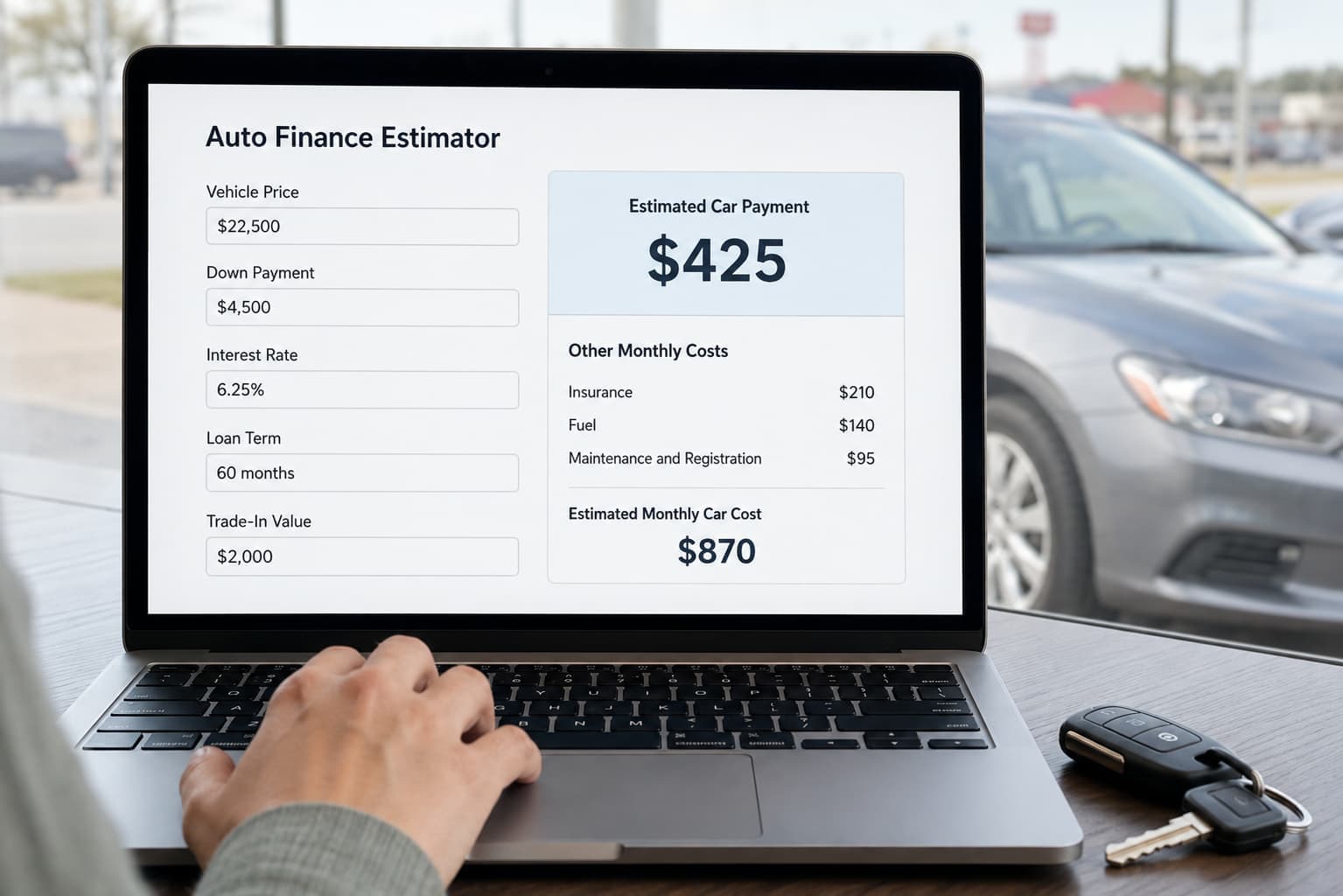
You enter the vehicle price, interest rate, and loan term into an auto finance estimator. The monthly payment appears, and it looks like something you can afford.
But that number only tells you what the loan may cost. It doesn’t include everything you’ll pay to keep the car on the road.
Insurance can make a particularly important difference. Two vehicles with similar prices and loan payments may cost very different amounts to insure. Once you add fuel, maintenance, registration, and other regular expenses, the car with the lower payment may not be the less expensive one to own.
Before signing the paperwork, take a few minutes to estimate the complete monthly cost. This guide will show you which expenses to add and why getting an insurance quote before you buy can help you choose a car that fits your budget.
What Does an Auto Finance Estimator Include?
Most auto finance estimators focus on the vehicle loan. Depending on the tool, you may be asked to enter:
- Vehicle price
- Down payment
- Trade-in value
- Interest rate
- Loan term
- Sales tax
- Title and registration fees
- Dealer fees included in the loan
The estimator uses those numbers to calculate an expected monthly payment. Some tools may also show the total amount financed and the interest you could pay over the life of the loan.
That information is helpful, but it doesn’t create a complete car budget.
Add These Costs to the Car Payment
You don’t need a complicated formula. Start by adding the expenses you expect to pay regularly:
Estimated monthly car cost = loan payment + insurance + fuel + maintenance + registration + parking and tolls
Some of those bills may not arrive every month. You can still include them by estimating the yearly cost and dividing it by 12.
For example, if registration and related vehicle fees cost about $240 per year, including $20 per month in your estimate gives that expense a place in the budget.
Your numbers do not need to be perfect. The goal is to avoid treating the loan payment as the entire cost of the car.
A Lower Payment Can Still Lead to a Higher Monthly Cost
Imagine you’re comparing two used vehicles.
Vehicle A has the lower purchase price and loan payment. Vehicle B costs a little more to finance, but its insurance and fuel estimates are lower.
| Monthly expense | Vehicle A | Vehicle B |
| Loan payment | $425 | $455 |
| Insurance quote | $210 | $145 |
| Fuel | $140 | $110 |
| Maintenance and registration | $95 | $80 |
| Estimated monthly total | $870 | $790 |
These figures are only an example, but they show why the payment isn’t the only number that matters.
Vehicle A appears to save $30 per month when you compare only the loans. After insurance and other ownership costs are included, Vehicle B costs $80 less per month in this example.
This won’t happen with every pair of vehicles. The point is to run the full monthly estimate before assuming the car with the lower payment is more affordable.
Check the Insurance Price Before You Buy
Insurance costs can change from one vehicle to another based on details such as:
- Year, make, and model
- Trim and engine
- Vehicle value
- Repair costs
- Safety equipment
- Theft and claims history
- How the vehicle will be used
- Estimated annual mileage
The drivers, location, insurance history, requested coverage, and deductibles may also affect the quote.
When possible, request the insurance quote using the vehicle identification number. If you don’t have the VIN yet, start with the exact year, make, model, and trim. You can update the quote when the dealership or seller provides the VIN.
You can request this quote before you own the car. In fact, doing it early gives you the opportunity to compare vehicles while you still have choices.
Financing May Affect the Insurance Cost
If you’re financing the vehicle, ask the lender what insurance coverage it requires before building your budget.
Lenders commonly require comprehensive and collision coverage while they have a financial interest in the car.
That means a liability-only estimate may not reflect the insurance policy you’ll need for a financed vehicle.
Ask the lender about:
- Required coverage
- Maximum deductible amounts
- When the policy must begin
- What proof of insurance you need
Once you know those requirements, request a quote that includes them. That will give you a more useful insurance number to place beside the loan payment.
Liability-only coverage can still be a practical, budget-conscious choice for some paid-off vehicles when it meets the legal requirements that apply to the driver.
Don’t Forget the Amount Needed Upfront
The monthly cost matters, but so does the amount you’ll need before driving the car home.
Depending on the purchase and policy, that could include:
- Down payment
- Taxes and fees not included in the loan
- First insurance payment
- Policy fees
- Registration
- Immediate maintenance or repairs
A monthly payment may fit your budget while the upfront amount stretches it too far. Review both numbers before agreeing to the purchase.
Run the Full Estimate Before You Sign
Before deciding that a car fits your budget:
- Run the auto finance estimator with the actual price, rate, fees, and loan term.
- Request an insurance quote for the vehicle.
- Estimate fuel, maintenance, registration, parking, and tolls.
- Add those amounts to the loan payment.
- Review the cash needed to complete the purchase.
- Compare the total with the rest of your monthly budget.
This quick review can give you a much more realistic picture than the loan payment alone.
Get the Insurance Number While You’re Still Comparing Cars
An auto finance estimator can help you understand the loan. Adding insurance and other ownership expenses helps you understand the car.
Once you know which vehicle you’re considering, CheapestAutoInsurance.com can use the vehicle and driver information to review the carrier options available through our agency. Our goal is to find the lowest rate we’re able to offer for the coverage you request.
You can start your car insurance quote online or call us at (800) 988-3794.
With the loan payment and insurance quote in front of you, you can make the decision with a clearer understanding of what the vehicle may cost each month.
Frequently Asked Questions
Does an Auto Finance Estimator Include Car Insurance?
Most auto finance estimators focus on the vehicle loan and do not automatically include car insurance. Check the tool’s inputs to confirm what it calculates. If insurance is not included, request a vehicle-specific quote and add it to your monthly estimate.
Can I Get an Insurance Quote Before Buying a Car?
Yes. You can generally request a quote before you own the vehicle. Provide the exact year, make, model, and trim, along with the VIN when available. The final price may change if the vehicle or other submitted information changes.
What Costs Should I Add to the Estimated Car Payment?
Add the expected insurance payment, fuel, maintenance, registration, parking, tolls, and other recurring vehicle expenses. You should also review the down payment, first insurance payment, taxes, and fees needed at the beginning.