
If you’ve opened your auto insurance renewal recently and noticed your premium increased, you’re not alone.
Over the past several years, drivers across the country have seen insurance rates rise—even if they haven’t had an accident or filed a claim. Naturally, many people begin looking for answers. Is it because of inflation? The economy? The stock market?
The answer is that they’re all connected—but not always in the way people expect.
The stock market doesn’t directly determine what you pay for car insurance. Insurance companies don’t raise premiums simply because the market had a bad week or lower them because stocks reached a new high.
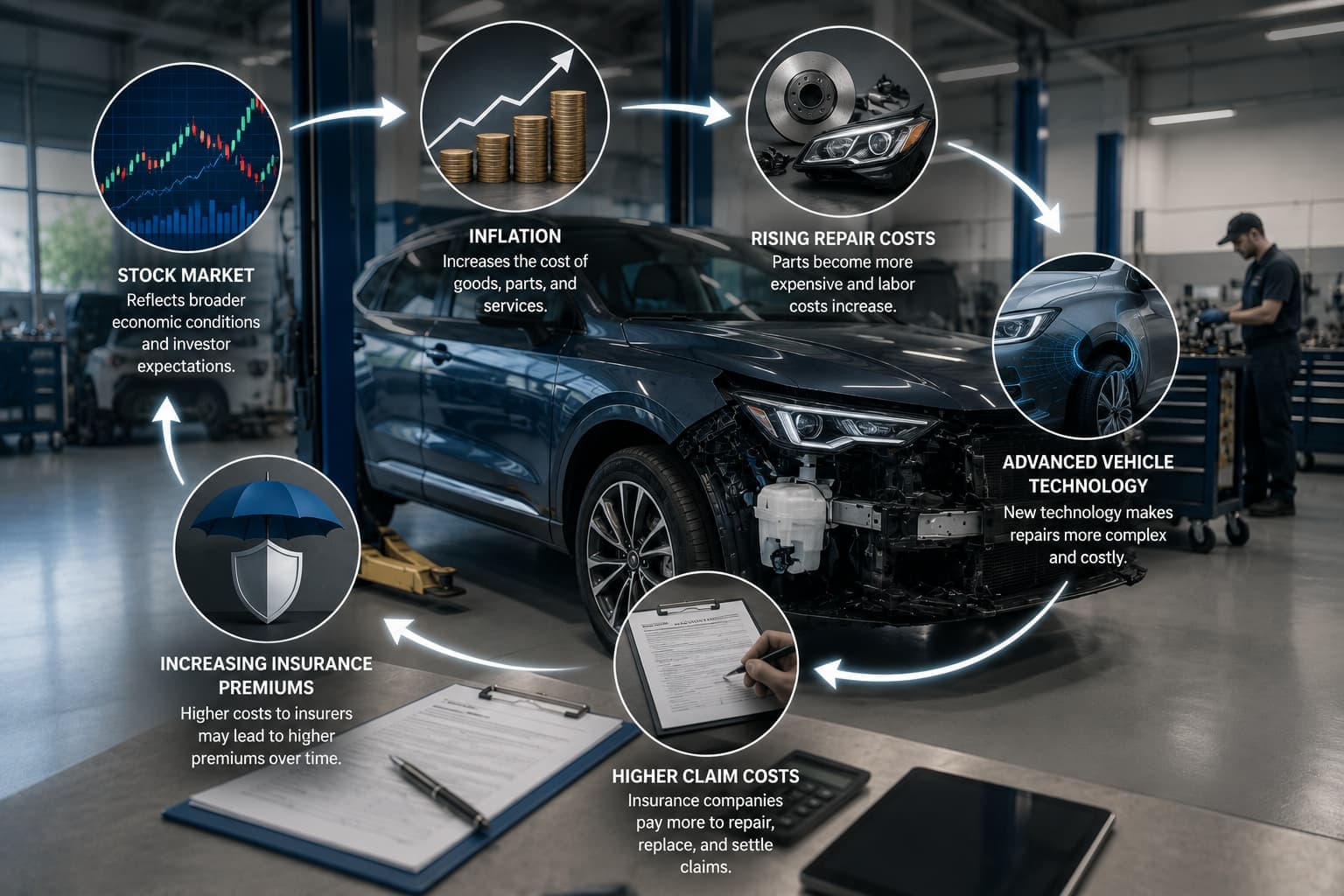
Instead, the stock market often reflects many of the same economic conditions that affect the insurance industry. Rising repair costs, more expensive vehicle technology, inflation, labor shortages, and increasing claim costs all play a much larger role in insurance pricing than daily market performance.
Understanding how those pieces fit together can make it easier to understand why insurance rates change—and why those changes can affect even safe drivers.
The Stock Market Isn’t What Raises Your Premium
It’s easy to connect a falling stock market with rising insurance rates, especially when both seem to happen around the same time.
However, insurance companies don’t base premiums on the daily performance of the Dow Jones, S&P 500, or Nasdaq.
Instead, insurance rates are developed using long-term trends that help insurers estimate what it will cost to provide coverage in the future.
That includes questions like:
- How much does the average accident cost today compared to a few years ago?
- Are replacement parts becoming more expensive?
- Are medical claims increasing?
- How often are vehicles being declared total losses?
- Are severe weather events leading to more claims?
These trends have a much greater impact on insurance pricing than short-term movements in the stock market.
So where does the stock market fit in?
Rather than being the cause of higher insurance rates, it’s often reacting to many of the same economic conditions that are increasing the cost of insurance.
Why Insurance Rates Have Increased in Recent Years
The biggest reason many drivers have seen higher premiums is simple:
Claims have become much more expensive.
When insurance companies pay more to repair vehicles, replace totaled cars, and settle injury claims, the overall cost of providing insurance increases.
Several factors have contributed to those rising costs:
- Inflation has increased the price of replacement parts.
- Repair shops face higher labor costs.
- New and used vehicles cost more to replace.
- Modern vehicles contain expensive technology that requires specialized repairs.
- Medical treatment costs continue to rise after accidents.
- Severe weather events have resulted in more claims in many parts of the country.
Individually, each of these factors increases claim costs.
Together, they can significantly change what it costs an insurance company to insure thousands—or even millions—of drivers.
That’s why insurance premiums sometimes increase even when your own driving record hasn’t changed.
The Economy Creates a Chain Reaction
One of the easiest ways to understand insurance pricing is to look at how changes in the economy affect the cost of a single claim.
It often follows a chain reaction like this:
| Economic Change | What Happens Next |
| Inflation increases | Manufacturing and transportation costs rise. |
| Vehicle parts become more expensive | Repair shops pay more for replacement parts. |
| Labor costs increase | Vehicle repairs take longer and cost more. |
| Vehicle values rise | Insurance companies pay more for total loss claims. |
| Medical expenses increase | Injury claims become more expensive to settle. |
| Claim costs rise | Insurance companies spend more paying covered losses. |
| Insurance companies request higher rates | Premiums may gradually increase over time. |
This is one of the biggest reasons people associate the stock market with insurance rates.
Both respond to broader economic conditions.
The difference is that the stock market reflects investor expectations, while insurance premiums reflect the actual cost of paying claims.
Where Your Insurance Dollar Goes
When you pay your insurance premium, that money supports much more than future claims.
Insurance companies generally use premium dollars to help cover several important expenses.
| Where Premium Dollars Go | Why It Matters |
| Paying claims | Covers vehicle repairs, medical expenses, and other covered losses. |
| Claims handling | Pays adjusters, inspections, investigations, and customer support. |
| Business operations | Supports employees, technology, billing systems, and customer service. |
| Reinsurance | Helps insurers manage catastrophic losses by sharing risk with other companies. |
| Investments | A portion of premiums may be invested until they’re needed to pay future claims. |
Investment income contributes to an insurance company’s overall financial performance, but claims remain its largest ongoing financial responsibility.
That’s why insurers generally pay much closer attention to the cost of settling claims than to short-term movements in the stock market.
A Fender Bender Isn’t So Simple Anymore
Not long ago, a minor rear-end collision often meant replacing a bumper, repairing a few dents, and applying a fresh coat of paint.
Today, that same accident can involve much more.
Many modern vehicles include technology hidden behind the bumper or windshield, including:
- Blind-spot monitoring sensors
- Backup cameras
- Parking sensors
- Adaptive cruise control radar
- Lane departure warning systems
- Automatic emergency braking components
After those parts are replaced, technicians often have to recalibrate the vehicle’s safety systems to ensure everything functions properly.
Even something as routine as replacing a windshield may require recalibrating cameras used for driver assistance features.
As a result, two accidents that look almost identical can have very different repair costs depending on the vehicle involved.
When these more expensive repairs become common across thousands of claims, the overall cost of providing insurance increases as well.
That’s one of the biggest reasons insurance premiums have risen over the past several years—not because the stock market changed, but because the average claim has become much more expensive to settle.
Why Your Insurance Rate Can Increase Even If You Haven’t Had an Accident
One of the most common questions drivers ask is:
“Why did my insurance go up when I haven’t filed a claim?”
It’s a fair question, and the answer surprises many people.
While your driving history is an important factor in determining your premium, it isn’t the only factor. Insurance companies also look at what it costs to insure drivers as a whole.
Imagine two drivers with identical records.
Neither has received a speeding ticket.
Neither has caused an accident.
Neither has filed a claim.
If the average cost of repairing vehicles, replacing totaled cars, and paying medical claims has increased across the industry, both drivers may still see higher premiums at renewal.
That’s because insurance is based on shared risk.
When claims become more expensive across thousands of policies, those higher costs can eventually influence rates for everyone—not just the drivers who recently filed claims.
This is one of the reasons many safe drivers have experienced premium increases in recent years.
Where the Stock Market Fits Into the Bigger Picture
So, if claims have the biggest influence on insurance pricing, why does the stock market get mentioned at all?
The answer is because both are affected by the same economic environment.
For example, during periods of economic uncertainty, you might see:
- Stock prices fluctuate.
- Inflation remain elevated.
- Supply chains become strained.
- Manufacturers pay more for raw materials.
- Businesses face higher operating costs.
Insurance companies experience many of these same pressures.
Higher costs for vehicle parts, labor, medical care, and replacement vehicles increase the amount insurers pay for claims. At the same time, investment returns may also become less predictable.
While investment performance can influence an insurance company’s overall financial results, it’s typically one piece of the puzzle—not the primary driver of insurance pricing.
Claims remain the largest ongoing expense, which is why insurers closely monitor claim costs when evaluating future rates.
Why Insurance Rates Don’t Change Overnight
Another common misconception is that insurance rates immediately follow changes in the economy.
In reality, pricing adjustments usually take much longer.
Insurance companies continuously monitor claim trends, repair costs, weather losses, and other financial data. If those trends suggest that the cost of providing coverage has increased, insurers may begin evaluating whether their current rates are still appropriate.
In many states, proposed rate changes must also be reviewed by state insurance regulators before they can take effect.
That means today’s insurance premium often reflects months—or even years—of claims data rather than what happened in the stock market last week.
Insurance pricing is designed to respond to long-term trends, not daily headlines.
What You Can Do When Insurance Costs Rise
While drivers can’t control inflation, vehicle prices, or the stock market, there are several ways to make sure you’re getting the best value from your policy.
Consider reviewing the following during your next renewal:
Compare Coverage—Not Just Price
If you’re shopping for insurance, compare policies with the same liability limits, deductibles, and optional coverages. A lower premium doesn’t always mean you’re receiving the same protection.
Review Your Deductible
A higher deductible may reduce your premium, but only choose an amount you could comfortably pay if you needed to file a claim.
Ask About Discounts
Many insurance companies offer discounts for safe driving, bundling policies, automatic payments, paperless billing, defensive driving courses, or insuring multiple vehicles.
Reevaluate Your Coverage
As your vehicle ages or your financial situation changes, it may be worth reviewing your coverages to make sure they still fit your needs.
Compare Quotes Periodically
Insurance companies evaluate risk differently, so rates can vary even when the coverage is identical. Comparing quotes every so often can help you determine whether you’re still receiving a competitive price.
Understanding Why Rates Change
Car insurance rates are influenced by much more than the stock market.
While investment performance can affect an insurance company’s overall financial health, the biggest driver of long-term pricing is usually the cost of paying claims.
As vehicle technology becomes more advanced, repair costs increase, medical expenses rise, and replacement vehicles become more expensive, insurers generally spend more settling covered losses. Those higher costs can eventually influence the premiums drivers pay—even if they’ve maintained a clean driving record.
The stock market is simply one part of a much larger economic picture.
Understanding that relationship helps explain why insurance rates can increase over time and why the answer often has more to do with the cost of repairing today’s vehicles than with what happened on Wall Street yesterday.
Frequently Asked Questions
Why are car insurance rates increasing?
Car insurance rates increase when the cost of providing coverage rises. More expensive vehicle parts, higher repair labor, advanced vehicle technology, rising medical expenses, severe weather losses, theft, and higher vehicle values can all make claims more expensive.
Why can my car insurance rate increase if I have not filed a claim?
Your driving and claims history are only part of your rate. Insurance companies also consider broader claim trends and the overall cost of insuring vehicles. When repairs, medical claims, and total-loss payments become more expensive, rates may increase even for drivers with clean records.
Can inflation increase car insurance rates?
Yes. Inflation can raise the cost of vehicle parts, repair labor, medical treatment, replacement vehicles, and other claim expenses. When insurers consistently pay more to settle claims, those higher costs may eventually affect premiums.