
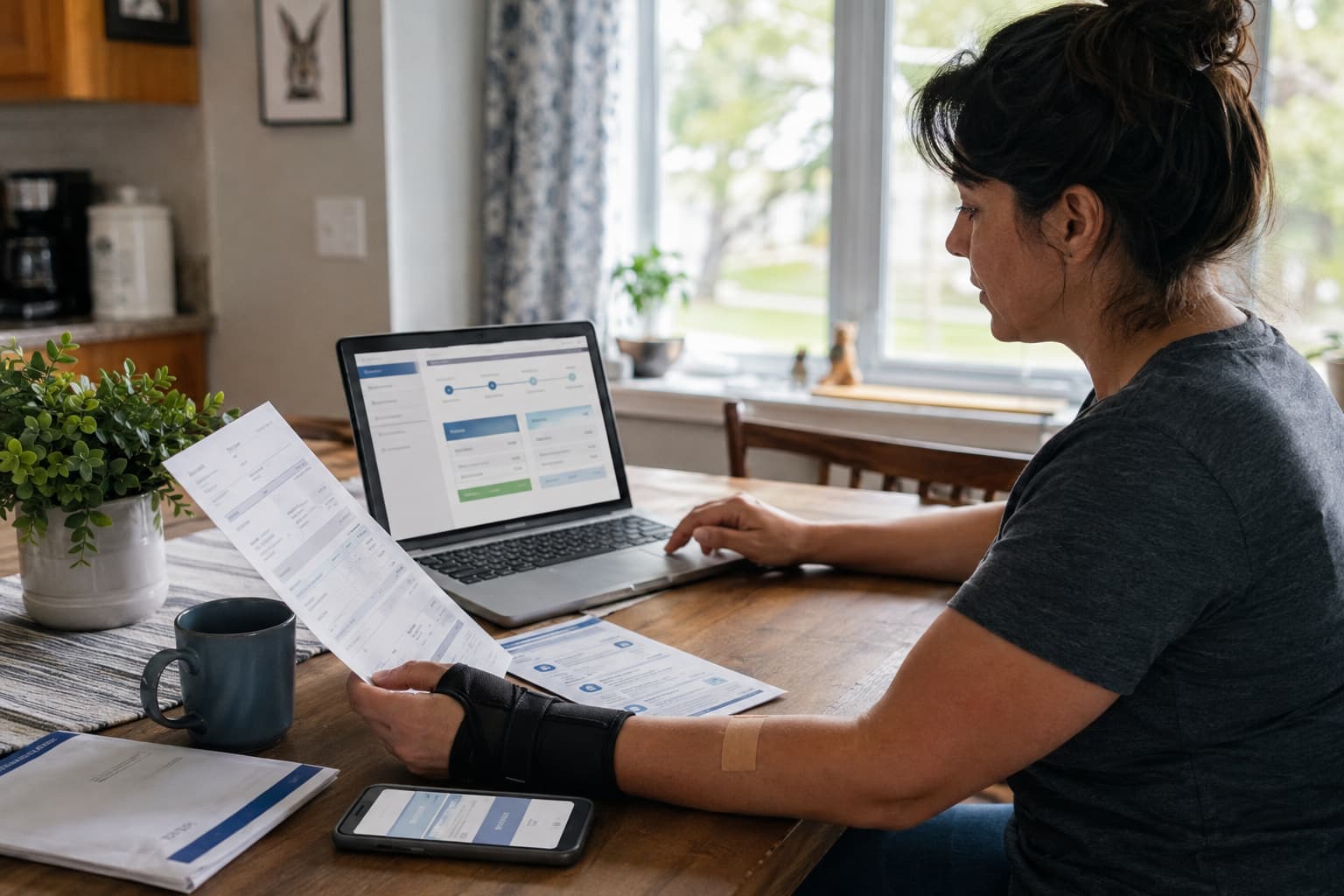
You got treatment after a car accident, and now the medical bills are showing up.
The problem? Your injury claim is still open.
Maybe the insurer is waiting on medical records. Maybe fault is still being reviewed. Maybe treatment isn’t finished yet. Whatever the reason, the medical provider’s billing schedule doesn’t always move at the same speed as the insurance claim.
That can leave you wondering what you’re supposed to do with a bill that’s due now when you expect insurance money later.
Before reaching for a credit card, find out exactly where the bill and claim stand. A provider payment plan may give you more time. If that doesn’t work, CareCredit may be another option at participating providers.
The goal isn’t to guess when the claim will pay.
It’s to find a way to handle the bill that still works if the claim takes longer than expected.
First, Find Out Why the Injury Claim Hasn’t Paid Yet
An injury claim can take time for several reasons.
The insurer may still be:
- collecting medical records
- reviewing bills
- investigating the accident
- determining fault
- confirming coverage
- waiting to understand the full extent of treatment or injuries
Before deciding how you’re going to pay a medical bill, ask what is actually holding up the claim.
If you have an adjuster, find out whether anything is missing.
If the insurer is waiting for records from the medical provider, for example, that is very different from a claim where liability is still being disputed.
Knowing the reason for the delay won’t necessarily make the claim pay immediately, but it gives you a much clearer idea of what you’re dealing with.
Check What the Medical Provider Has Already Billed
The amount on a statement isn’t always the end of the story.
Before putting a medical bill on a payment plan or credit account, contact the provider and ask:
- Has health insurance already been billed?
- Has anything been adjusted, denied, or sent back for more information?
- Has the provider submitted the bill or records related to the auto claim?
- Is anything still pending?
- What amount is actually due from me right now?
- When is that amount due?
This step matters because you don’t want to finance a balance that may still change.
Suppose you receive a $2,500 bill and immediately put the full amount on credit.
A week later, an insurance adjustment reduces what you actually owed.
Now you’ve created an extra refund or billing issue that may have been avoided by checking the account first.
Make sure you’re solving the bill you actually owe—not simply the first number that appeared on a statement.
Don’t Ignore the Bill Just Because the Claim Is Open
It’s easy to assume the medical provider will simply wait because everyone knows there’s an insurance claim.
Don’t count on that.
The provider and the insurer are operating on different timelines. A medical office may still send statements or expect payment while the claim is being reviewed.
Instead of ignoring the bill, call the provider.
Ask:
- Can the due date be extended while the claim is pending?
- Can the account be placed on a temporary payment arrangement?
- Will the provider continue working with the insurer?
- Is there anything you need to submit?
- What happens if insurance pays after you’ve already made a payment?
You may find that the provider has more flexibility than the bill itself suggests.
That brings you to your first alternative.
Option 1: Ask About a Provider Payment Plan
Before opening another credit account, see what the medical provider offers directly.
Depending on the provider, options may include:
- monthly payments
- additional time to pay
- financial assistance
- reduced-payment programs
- other internal billing arrangements
Ask for the details rather than assuming a “payment plan” automatically means a better deal.
Find out:
- whether interest is charged
- whether there are fees
- what the monthly payment would be
- how long you have to pay
- whether there is a penalty for paying early
- how a later insurance payment would be handled
A provider payment arrangement can be worth comparing because it may let you deal directly with the same organization that holds the medical bill.
If that option doesn’t work—or the provider requires another form of payment—then CareCredit may be worth considering.
Option 2: CareCredit May Give You Another Way to Handle the Bill
CareCredit can be used for eligible health care expenses at participating providers.
The important thing to understand is what happens once you use it.
CareCredit pays the provider through a credit transaction. You then owe the CareCredit balance under the terms of the account.
That balance does not become part of your injury claim simply because the medical expense came from a car accident.
So if you’re considering whether to use CareCredit before an injury claim pays, don’t build the decision around the assumption that insurance will quickly pay off the card.
The claim might:
- take longer than expected
- pay a different amount than expected
- send payment somewhere other than the card
- remain disputed
- be subject to applicable coverage limits
CareCredit may help solve a timing problem.
Just make sure it doesn’t create a payment problem you couldn’t manage without the insurance money.
The CareCredit Timeline Doesn’t Pause for the Insurance Claim
This is probably the most important thing to remember if you use medical credit while a claim is still open.
The two timelines are separate.
Imagine you have a $2,000 medical bill.
You expect the injury claim to be resolved soon, so you put the bill on CareCredit.
Two months pass.
The insurer is still waiting on additional records.
Then another month goes by.
The claim is still open.
Your CareCredit account hasn’t been waiting alongside it. Your payments and any promotional financing terms continue according to the agreement.
Depending on the offer, CareCredit purchases may come with promotional financing terms that need to be followed carefully. Some promotions may involve deferred interest, meaning the consequences of missing the payoff deadline can be much different from simply having a normal interest-free period.
Before accepting an offer, look at:
- the promotional period
- minimum payments
- interest terms
- the payoff deadline
- what happens if the balance remains when the promotion ends
Then ask yourself one question:
Could I still manage this balance if the injury claim takes several more months?
If the answer is no, relying on a hoped-for insurance payment becomes risky.
If Insurance Pays Later, Find Out Where the Money Went
Here’s something that’s easy to overlook.
Suppose you already paid the provider with CareCredit.
Then insurance eventually pays part of the medical bill.
Your CareCredit balance may not automatically drop by the amount insurance paid.
You need to find out where the payment went.
For example:
You put a $1,500 medical bill on CareCredit.
Several weeks later, the insurer sends $1,000 to the medical provider for that same bill.
The provider may now have received more money toward the bill than it was ultimately owed.
That doesn’t necessarily mean $1,000 instantly appears on your CareCredit account.
You may need to ask:
- Did the insurer pay the provider or send payment to me?
- Did the provider receive payment for a balance I already paid?
- Is there now an overpayment?
- Will the provider issue a refund?
- Where will that refund be sent?
- Has any refund or credit actually posted?
Keep following the money until every account matches.
A medical bill showing paid, an insurance payment showing issued, and a CareCredit balance showing unpaid can all exist at the same time until the transactions are properly reconciled.
Keep the Claim and Medical Bill Records Together
When several organizations are involved, even a simple bill can become surprisingly hard to follow.
Keep a basic record of:
- itemized medical bills
- dates of treatment
- health insurance explanations of benefits, if applicable
- auto claim number
- adjuster contact information
- provider payment-plan terms
- CareCredit receipts and financing terms if used
- payments made by insurance
- refunds or credits issued later
You don’t need a complicated filing system.
You just need to be able to answer:
Who billed what, who paid what, and what is still owed?
That becomes especially important if the insurance claim pays after you’ve already handled part of the bill yourself.
What to Do While You’re Waiting for an Injury Claim to Pay
If a medical bill is due and the injury claim is still open, work through the problem in this order.
1. Ask why the claim is still pending
Find out whether the insurer is waiting on medical records, bills, fault information, treatment updates, or something else.
2. Confirm the amount you actually owe
Ask the provider what has already been billed, adjusted, or submitted to insurance.
3. Ask whether the provider can give you more time
A due-date extension or direct payment plan may solve the immediate problem without opening another credit account.
4. Compare CareCredit if you still need another option
Look at the financing terms, monthly payment, promotional deadline, and what happens if the balance isn’t paid in time.
5. Don’t rely entirely on the injury claim as your payoff plan
Choose an option you could still manage if the claim takes longer than expected or pays differently than you hoped.
6. Check every account if insurance pays later
Make sure any payment, refund, or credit actually ends up where it is supposed to go.
The important part isn’t finding the option that assumes insurance will pay tomorrow.
It’s finding the option that still works if tomorrow turns into another month.
Frequently Asked Questions
Do I have to pay medical bills while an injury claim is still open?
A pending injury claim does not automatically put a medical bill on hold. Ask the provider what amount is currently due, what has already been submitted to insurance, and whether additional time or a payment arrangement is available.
Can a medical provider wait for an auto insurance claim to pay?
Some providers may be willing to work with patients while a claim is pending, but policies vary. Contact the billing department directly and ask what options are available rather than assuming the account will automatically be held.
Can I use CareCredit for medical bills after a car accident?
CareCredit may be used for eligible health care expenses at participating providers, subject to approval and account terms. Using CareCredit does not make the credit balance part of the auto insurance claim.
Should I use CareCredit if I’m expecting an insurance settlement?
Don’t base the decision solely on an expected settlement or claim payment. Consider whether you could manage the CareCredit balance if the claim is delayed or pays less than expected.
What happens if insurance pays after I already paid the medical bill?
Check where the insurance payment was sent. If the provider receives payment for a bill you already paid, there may be a refund or credit to sort out, and it may not automatically reduce another account you used to pay the bill.
What should I ask before putting a medical bill on CareCredit?
Confirm the amount actually due, whether insurance billing is complete, whether the provider offers a payment plan or financial assistance, and whether you could repay the CareCredit balance even if the injury claim remains open longer than expected.