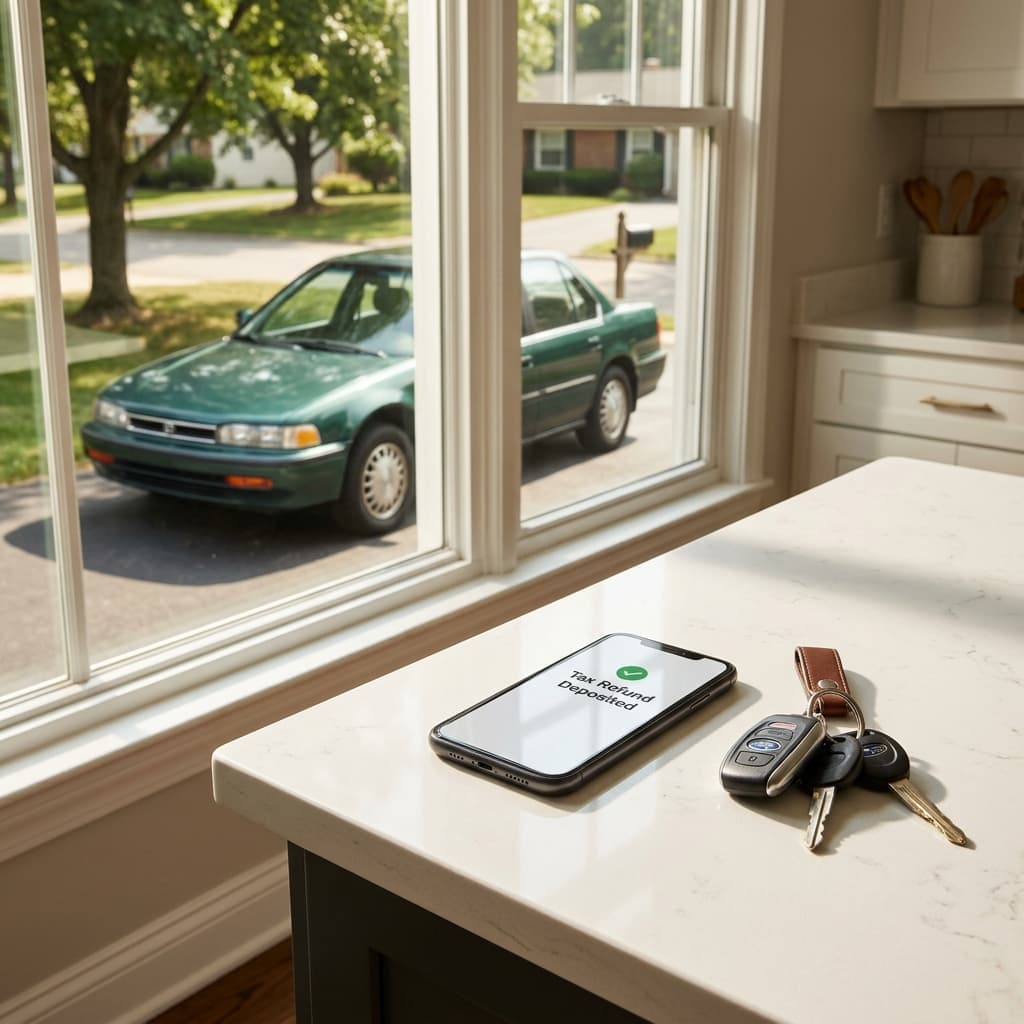
Most tax refunds are spent before they ever reach the bank account.
Maybe you’ve already planned to replace the tires that barely made it through winter. Maybe you’ve promised yourself you’ll finally pay down a credit card, fix something around the house, or take the weekend trip you’ve been putting off.
By the time the refund actually arrives, every dollar already has a job.
If you’re like many drivers, car insurance probably isn’t at the top of that list.
It isn’t exciting. You don’t get to unwrap it, drive it, or show it off. It’s easy to think of insurance as the bill you’ll figure out next month.
But what if part of your tax refund could solve more than this month’s insurance payment?
What if it could remove months of financial stress instead?
That’s why using your tax refund to pay car insurance ahead can be one of the smartest financial decisions you make all year. It doesn’t just pay a bill. It creates breathing room in your budget, reduces the chance of missing a payment, and gives you time to prepare for the next policy renewal instead of constantly trying to catch up.
The goal isn’t simply to spend your refund.
It’s to make it keep working long after it’s been deposited.
Before You Spend Your Refund, Make Sure It’s Actually There
One of the easiest financial mistakes people make is spending money they haven’t received yet.
The IRS provides a “Where’s My Refund?” tool that lets taxpayers check the status of their refund after their tax return has been processed. Depending on how you filed your return and whether additional review is required, the timing can vary.
That’s why it’s important not to build your insurance plan around money that hasn’t reached your account.
If your policy is already close to its due date—or worse, nearing cancellation—don’t wait and hope your refund arrives in time.
Instead, call your insurance company or your insurance agent and ask a few simple questions:
- How much do I need to pay to keep my policy active?
- When is the actual cancellation date?
- Are there any payment options available before the policy cancels?
- If my refund arrives next week, what should I do today?
Those answers can prevent a temporary cash-flow problem from turning into a much bigger insurance problem.
A tax refund can be an excellent financial tool, but only after it becomes real money sitting in your bank account.
Getting Current Isn’t the Same as Getting Ahead
Imagine your refund finally arrives.
Your first thought might be:
“I’ll just catch up on my insurance.”
If your policy is behind, that’s absolutely the right first step.
But here’s a question many people never ask themselves.
What happens next month?
If your refund only pays the amount that’s already overdue, you’re right back where you started when the next payment comes due.
Nothing has really changed.
Now imagine a different situation.
Your policy is already current, and instead of making only the next monthly payment, you’re able to pay several months ahead—or even pay the entire six-month policy term if your insurance company offers that option.
Suddenly, your budget looks different.
Instead of wondering where next month’s insurance payment will come from, you already know it’s covered.
That doesn’t just reduce a bill.
It reduces stress.
It gives you time to focus on other financial priorities without worrying that your insurance payment is waiting around the corner.
That’s the difference between catching up and getting ahead.
One solves yesterday’s problem.
The other changes the next several months.
Decide What Problem Your Refund Is Actually Solving
Before you spend a single dollar of your refund, ask yourself one simple question:
What problem am I trying to solve?
That answer should determine how you use the money.
For example, if your policy is about to cancel because you’re behind on payments, keeping your insurance active becomes the priority.
If your insurance is already current but always strains your monthly budget, paying ahead may create the breathing room you’ve been looking for.
If you’ve recently financed a vehicle and your current policy no longer meets the lender’s insurance requirements, your refund may be an opportunity to bring your coverage back into compliance.
Each of those situations has a different solution.
That’s why it’s important to think beyond the refund itself.
A tax refund isn’t valuable simply because it’s extra money.
It’s valuable because it gives you a chance to solve a financial problem before it becomes urgent.
Too often, refunds disappear on purchases that provide short-term satisfaction but don’t change anything about next month’s budget.
Using part of that refund to stabilize your insurance may not feel exciting today, but it can make the next several months much easier to manage.
Before You Spend Your Refund
Ask yourself:
✅ Am I solving next month’s problem—or only today’s?
✅ Is my insurance already current?
✅ Would paying ahead reduce financial stress?
✅ Does my current coverage still fit my vehicle?
✅ Have I asked whether my insurer offers a paid-in-full discount or lower installment fees?
Sometimes the smartest financial decision isn’t the most exciting purchase.
Sometimes it’s the one that gives you fewer bills to worry about next month.
Paying Your Policy in Full Isn’t Always the Goal—Getting Ahead Is
Many insurance companies offer policies that renew every six months. Depending on the company, paying the entire premium upfront may qualify you for a paid-in-full discount or help you avoid monthly installment fees. Those savings vary by insurer, so it’s always worth asking before you decide how to use your refund.
But here’s something people often overlook.
The goal isn’t simply to pay your policy in full.
The goal is to improve your financial situation.
For some drivers, paying the entire six-month premium makes perfect sense. It removes one recurring bill from the budget and provides peace of mind for months to come.
For others, using the entire refund on insurance may not be the best choice if it means falling behind on rent, utilities, groceries, or other essential expenses.
Think about your refund as a tool—not a rule.
The smartest decision is the one that leaves your overall financial picture stronger than it was before the refund arrived.
Sometimes that’s paying six months ahead.
Sometimes it’s paying several months ahead while keeping enough money aside for other priorities.
The important thing is making a decision with intention instead of spending the refund as quickly as it arrives.
Don’t Let Six Months of Breathing Room Turn Into Six Months of Waiting
Imagine you use your refund to pay your insurance six months in advance.
For a while, it feels great.
Every month that passes is one less bill to worry about.
Then something happens that catches a lot of people by surprise.
The renewal notice arrives.
If nothing has changed in your budget during those six months, you’re right back where you started.
The refund gave you breathing room—but it wasn’t meant to be six months of doing nothing.
It was six months to prepare.
One of the smartest habits you can build is pretending your insurance payment never disappeared.
Let’s say your six-month premium was $720.
Instead of forgetting about insurance until renewal, divide that amount across the months before it’s due again. Setting aside even a small amount from each paycheck or benefit payment can make the next renewal feel much more manageable.
That’s how a tax refund changes more than one bill.
It changes your routine.
Instead of relying on next year’s refund to rescue your budget again, you’ve started building the next insurance payment before it becomes urgent.
That’s real financial progress.
Before You Pay Ahead, Make Sure Your Coverage Still Fits Your Vehicle
A tax refund is also a good opportunity to review your policy before you make a large payment.
After all, paying ahead only makes sense if you’re paying for the coverage you actually need.
Ask yourself a few questions.
Has anything changed since your policy started?
Did you pay off your vehicle?
Have you started driving fewer miles each year?
Has another driver moved into or out of your household?
If your vehicle is financed or leased, your lender will typically require comprehensive and collision coverage until the loan is paid off. If you’ve recently paid off your vehicle, it may be worth reviewing your coverage with your insurance agent before paying the next policy term.
On the other hand, if you recently financed a newer vehicle, now is the time to confirm your policy meets your lender’s requirements before sending payment.
The goal isn’t automatically lowering your coverage or increasing it.
The goal is making sure your policy matches your current situation.
A five-minute policy review today could help prevent paying for coverage that no longer fits—or discovering too late that your lender requires coverage you don’t currently have.
A Tax Refund Is Also a Good Time to Compare Quotes
Before committing hundreds of dollars toward your next policy term, take a few minutes to see what’s available.
Insurance rates change more often than many drivers realize.
A company that offered the best rate six months ago may not be the lowest-priced option today.
That doesn’t mean you should chase the cheapest quote you can find.
It means you should compare policies that include the same liability limits, deductibles, and coverages.
Otherwise, two quotes may look completely different on price while protecting you very differently after an accident.
Comparing quotes before paying ahead gives you confidence that you’re putting your refund toward a policy that fits both your budget and your coverage needs.
One Deposit Can Change More Than One Month
A tax refund usually arrives once a year.
That’s one reason it’s easy to think of it as spending money.
But it can also be planning money.
One deposit has the ability to solve problems that repeat every month.
If part of your refund removes six months of insurance payments, helps you avoid installment fees where available, or simply gives your budget room to breathe, the value lasts much longer than the day the money hits your account.
The smartest use of a tax refund isn’t always the purchase you’ll remember most.
Sometimes it’s the decision that makes life feel a little less stressful long after the refund itself is gone.
Your Tax Refund Won’t Last Forever—The Benefits Can
Every tax refund eventually gets spent.
The question is whether it’s spent in a way that changes anything after the money is gone.
New electronics eventually become old. Weekend trips come to an end. Even home projects eventually fade into the background. There’s nothing wrong with using part of your refund for things you enjoy or have been putting off.
But if car insurance is the bill that seems to cause the most stress throughout the year, using part of your refund to get ahead may provide something even more valuable than a purchase.
It provides stability.
Instead of wondering whether you’ll have enough to make next month’s payment, you’ve already created room in your budget. Instead of reacting to every due date, you’ve given yourself time to prepare for the next one.
That’s what makes paying ahead different from simply paying a bill.
You’re buying time.
You’re reducing financial pressure.
And you’re giving yourself a chance to build better habits before the next renewal arrives.
If you’re planning how to use your tax refund this year, don’t just ask yourself what you want to buy.
Ask yourself what financial problem you want to solve.
Sometimes, the smartest purchase is the one you never have to think about again.
Frequently Asked Questions
Can I use my tax refund to pay my car insurance?
Yes. You can generally use your tax refund to catch up on overdue premiums, pay several months ahead, or pay your policy in full if your insurance company offers that billing option.
Is it cheaper to pay car insurance in full?
It can be. Some insurance companies offer a paid-in-full discount or waive monthly installment fees when the entire policy term is paid upfront. Discounts and billing options vary by insurer, so ask your insurance company before making a payment.
Should I wait for my tax refund if my insurance payment is due?
No. If your payment is due before your refund arrives, contact your insurance company or agent immediately. Waiting could result in late fees, a lapse in coverage, or policy cancellation if payment isn’t received by the required date.
Is paying ahead better than just making the monthly payment?
If paying ahead fits your budget, it can reduce financial stress by removing one recurring monthly expense for a period of time. It may also help you avoid missing future payments if your income changes from month to month.
Should I compare insurance quotes before paying my policy in full?
Yes. Before paying several months in advance, compare quotes with the same liability limits, deductibles, and coverages. A lower premium isn’t always the better value if the policy provides less protection than your current coverage.
What’s the smartest way to use a tax refund for car insurance?
The smartest approach is the one that improves your overall financial situation. For some drivers, that’s catching up on overdue payments. For others, it’s paying ahead, taking advantage of available discounts, or reviewing coverage to make sure it still fits their vehicle and budget.