
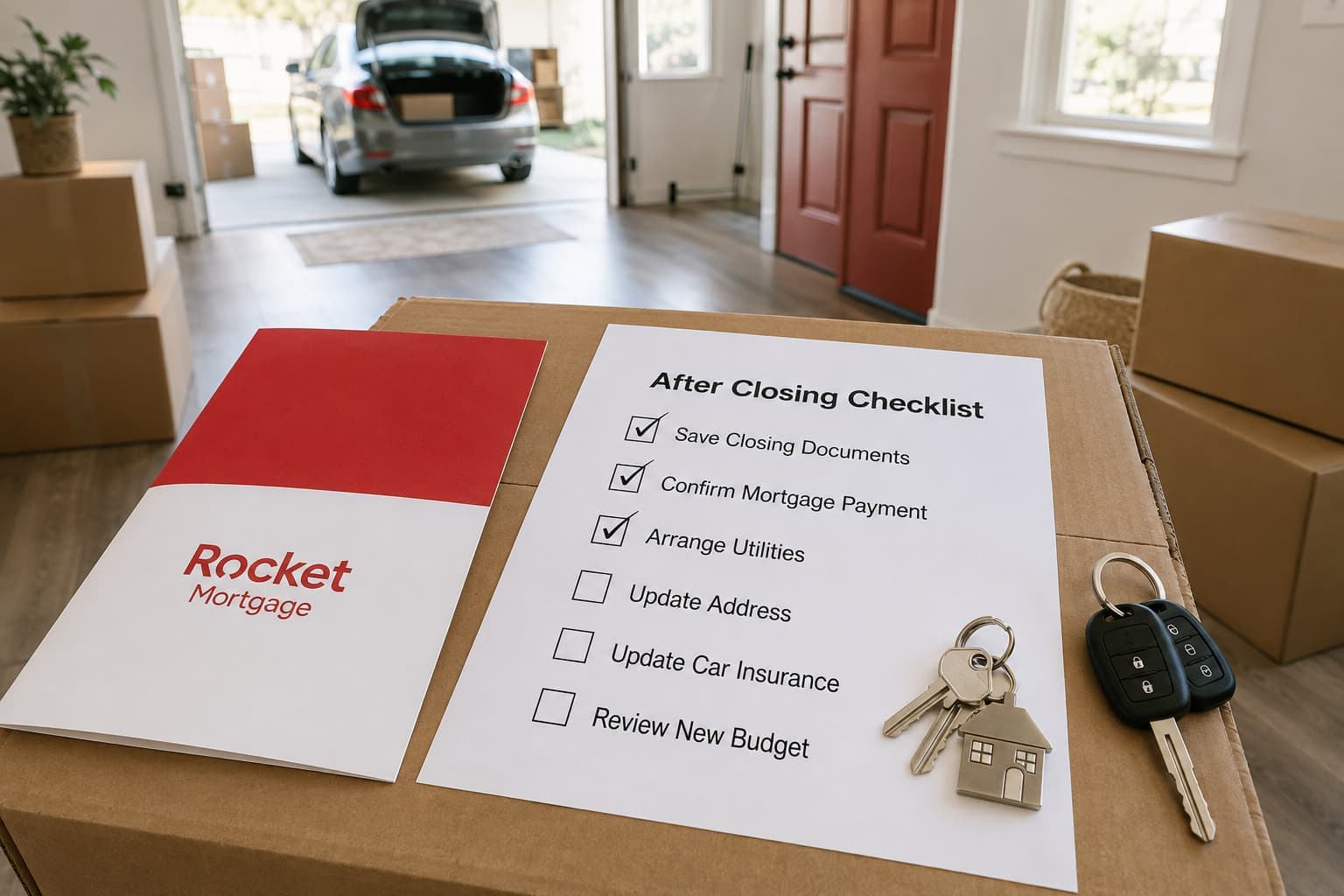
You signed the paperwork, received the keys, and officially own the house.
Take a moment to enjoy it.
Then, when you’re ready, start working through the practical side of moving in. Some tasks need attention before the first box arrives. Others can wait until you have settled in for a few days.
Your car insurance belongs on the list too.
A new home can change where your vehicle is kept, how far you drive to work, where you park, who lives in your household, and how your automatic payments are handled. Rocket Mortgage does not automatically send those changes to your auto insurer.
Breaking the work into three stages—before moving, during moving week, and after settling in—can make the transition feel much more manageable.
Start With Your Rocket Mortgage Documents
Rocket Mortgage’s guide to what happens after closing recommends organizing important documents, confirming payment information, updating your address, and preparing the home for move-in.
Keep your closing records somewhere you can find them easily. These may include:
- Closing Disclosure
- Mortgage note
- Deed or ownership documents provided at closing
- Title-insurance information
- Homeowners-insurance policy
- Inspection report
- Repair records
- Home-warranty information, if applicable
Consider keeping digital copies as well as the original documents. A secure folder can be easier to access later when you need to check a loan term, insurance detail, or home repair.
Confirm Your First Mortgage Payment
Do not assume the first payment is due exactly one month after closing.
Review the closing documents and any welcome information from Rocket Mortgage for:
- First payment date
- Payment amount
- Official payment method
- Mortgage account information
- Whether automatic payments are active
Use Rocket Mortgage’s official website, app, documents, or verified contact information when setting up payments.
Add the due date to your calendar even if you plan to use automatic payments. Checking the first draft can help you catch an account or setup problem before the payment becomes late.
Arrange Utilities Before Moving Day
Try to have essential services ready by the time you move in.
Your list may include:
- Electricity
- Natural gas
- Water
- Trash and recycling
- Internet
- Security service
Ask whether any provider requires a deposit, installation appointment, or account-transfer fee.
If you are moving out of another home, coordinate the end date for the old utilities too. Leave enough time to finish cleaning, complete a final walkthrough, or return keys without losing electricity or water too early.
Decide When the Car Is Actually Moving
The closing date and the move-in date are not always the same.
You might close on June 1 but stay in your apartment until June 15. During those two weeks, the new house belongs to you, but your car may still spend every night at the apartment.
That timing matters for car insurance.
Contact your insurer or agency before the move, explain both dates, and ask when the new address should take effect. Do not assume the policy change should automatically match the mortgage-closing date.
The important date is when the information connected to the car actually changes.
Update Your Car Insurance for the New Home
Once the car moves, the policy should reflect where it is being kept and how it is being used.
Review the following information with your insurer or agency:
- Mailing address
- Primary garaging address
- Parking arrangement
- Commute
- Estimated annual mileage
- Vehicle use
- Household drivers
- Contact information
- Automatic-payment details
The mailing address is where insurance documents are sent. The garaging address describes where the car is primarily kept.
They may be the same after the move, but they are not interchangeable. Updating the mailing address alone may not tell the insurer that the vehicle now lives somewhere else.
Review Your New Commute and Mileage
A new home can change your daily drive even if your job stays the same.
Your commute may become shorter or longer. You may begin working remotely, take a different route, or drive more miles for school and family responsibilities.
Give the insurer the most realistic estimate you can. If your routine is uncertain during the move, ask whether you should provide an initial estimate and update it after you have settled into the new schedule.
A shorter commute does not guarantee a lower premium. Location, vehicle use, mileage, drivers, coverage, and other permitted rating factors may affect the result.
The move may raise, lower, or leave the rate unchanged. The goal is to make sure the policy reflects the new routine.
Tell the Insurer About Household Changes
Buying a house sometimes means combining households.
A spouse, partner, adult child, parent, roommate, or another licensed person may now live at the address and have access to a vehicle.
Ask the insurer how each household member should be handled. Do not assume that occasional permission, regular access, listing, exclusion, and coverage all mean the same thing.
Also mention if:
- A driver moved out
- Someone now regularly uses a different vehicle
- A car was sold during the move
- A vehicle is stored somewhere else
- A household member began driving more often
It is easier to answer those questions during the move than after a claim.
Check Your Car-Insurance Payment Method
Moving often happens alongside changes in banking, cards, email addresses, or billing information.
Confirm:
- The account or card used for payments
- Billing address
- Card expiration date
- Email address
- Next payment date
- Whether automatic payment is still active
A mortgage escrow account may handle homeowners insurance and property taxes, depending on the loan. It generally does not pay a separate personal auto policy.
Your car-insurance payment will continue through the payment method arranged with the insurer.
If the move includes changing banks, our guide to changing banks without missing a car-insurance payment can help you plan the transition.
Take Extra Care When Moving to Another State
An interstate move may require more than editing the address on the current policy.
Insurance requirements, policy forms, available coverage, registration rules, and licensing deadlines can vary by state. Your current insurance company may need to issue a different policy, or it may not offer coverage in the new location.
Contact the insurer before moving and ask:
- Whether the current policy can continue
- When a new policy should begin
- What coverage the new state requires
- When the old policy should end
- Which documents you will need
- Whether new insurance cards will be issued
Do not cancel the existing policy until replacement coverage is confirmed.
Check the new state’s motor-vehicle agency separately for driver’s-license and registration deadlines.
Make the New Home Safe Before You Fully Unpack
A few simple tasks can make the house safer and easier to manage.
During the first few days:
- Change or rekey exterior locks
- Test smoke alarms
- Test carbon-monoxide alarms
- Locate the main water shutoff
- Find the electrical panel
- Check fire extinguishers
- Update alarm or smart-home access
- Photograph the home before unpacking
- Store emergency contact information somewhere visible
You may not know every detail about the house yet. Begin with the items that would matter during an emergency.
Update Your Address With the Right Places
Forwarding mail is helpful, but it does not update every account automatically.
Depending on your situation, you may need to notify:
- Postal service
- Banks and credit-card companies
- Employer
- Healthcare providers
- Insurance companies
- Subscription services
- Driver’s-license agency
- Vehicle-registration agency
- Other lenders or financial institutions
State deadlines for licenses and vehicle registration vary. Check the motor-vehicle agency for the state where you now live.
Review the Updated Insurance Documents
After the auto insurer processes the change, do not stop at the confirmation email.
Review the updated declarations page and insurance cards for:
- Mailing address
- Garaging address
- Drivers
- Vehicles
- Coverage limits
- Deductibles
- Optional coverages
- Premium
- Payment schedule
- Effective date
If something does not match what you discussed, contact the insurer or agency while the conversation is still fresh.
Keep the updated documents with your other moving and closing records.
Check the New Budget After the First Month
The first month in a new home can reveal expenses that were difficult to estimate before moving.
Compare your expected budget with what you actually paid for:
- Mortgage
- Utilities
- Home maintenance
- Transportation
- Car insurance
- Fuel
- Parking or tolls
- Household services
You may find that the new commute costs more, the utilities cost less, or the insurance payment changed with the address.
Your After-Closing Moving Checklist
Before moving
- Save your closing documents.
- Confirm the first mortgage-payment date.
- Set up official mortgage-account access.
- Arrange utilities.
- Decide when the household and vehicles will move.
- Contact your auto insurer or agency about timing.
During moving week
- Update mailing and garaging addresses.
- Review commute, mileage, parking, and vehicle use.
- Report household-driver changes.
- Check automatic-payment information.
- Change or rekey exterior locks.
- Test alarms and locate emergency shutoffs.
After moving
- Review updated insurance documents.
- Update your mailing address and accounts.
- Check state licensing and registration requirements.
- Confirm the next mortgage and insurance payments.
- Compare your first month’s expenses with the new budget.
- Save the updated records with your closing paperwork.
Let Your Car Insurance Move With You
Closing with Rocket Mortgage completes the home purchase. It does not automatically update the policy attached to your car.
Use the move as a reminder to review the garaging address, commute, mileage, household drivers, payment information, and effective date.
CheapestAutoInsurance.com can update your information and review the carrier options available through our agency. Our goal is to find the lowest rate we are able to offer for your updated information and requested coverage.
You can start your quote online or call us at (800) 988-3794.
Frequently Asked Questions
What Should I Do After Closing on a House With Rocket Mortgage?
Save your closing documents, confirm the first mortgage payment, arrange utilities, secure the home, update your address, review insurance policies, and check your new household budget. Break the work into tasks for before moving, moving week, and after settling in.
Does Rocket Mortgage Update My Car Insurance?
No. Your personal auto policy is separate from the mortgage closing. Contact your car-insurance company or agency to update the garaging address, mailing address, commute, mileage, household drivers, and other information affected by the move.
When Should I Change My Car-Insurance Address After Moving?
Contact the insurer before the move and explain both the closing date and the date the vehicle will begin staying at the new home. Ask when the new garaging address should take effect. Do not assume it should automatically match the closing date.
Can Moving to a New House Change My Car-Insurance Rate?
It may. Location, parking, commute, mileage, household drivers, vehicle use, coverage, and other permitted factors can affect pricing. The move may raise, lower, or leave the premium unchanged.
Is Car Insurance Included in Mortgage Escrow?
Generally, no. Mortgage escrow may collect money for property taxes and homeowners insurance, depending on the loan. A separate personal auto policy is normally paid through the payment method arranged with the car insurer.